 dowidth.com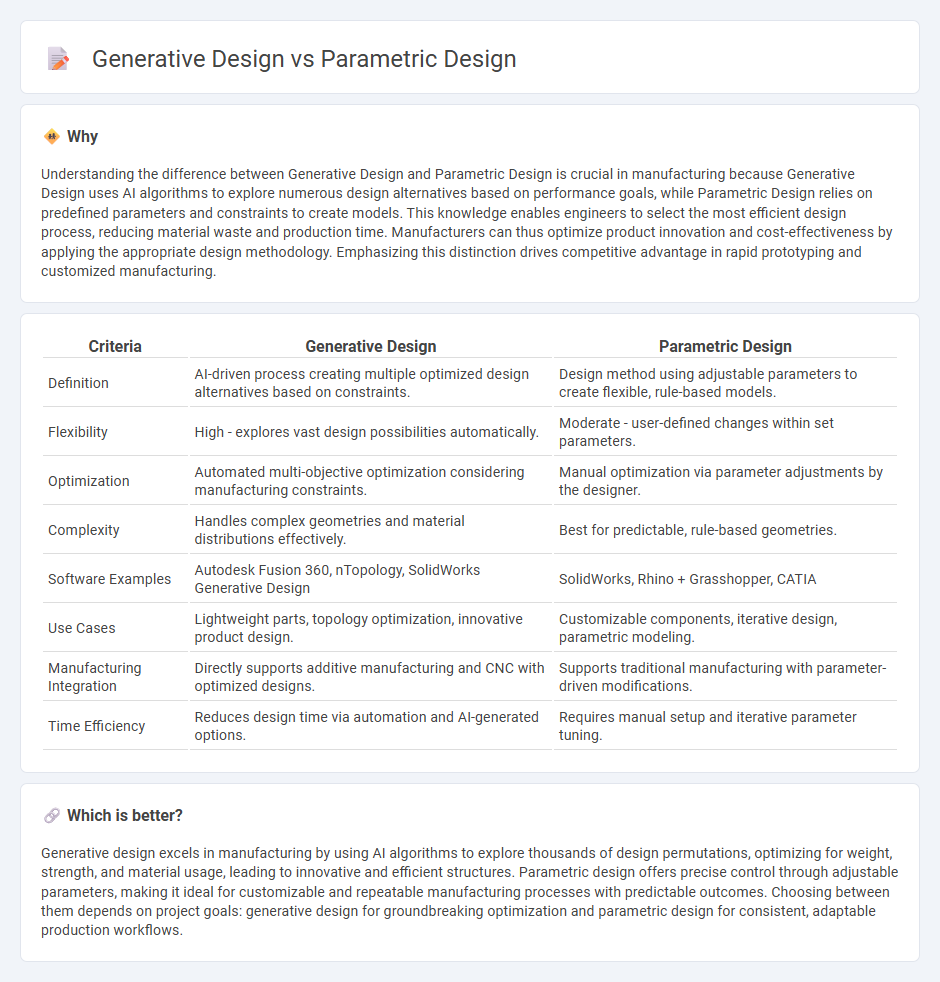
Generative design leverages artificial intelligence algorithms to create optimized and innovative design solutions based on specified constraints and goals, while parametric design relies on adjustable parameters and defined relationships to systematically alter designs. Both approaches enhance manufacturing efficiency and precision but differ in their flexibility and automation levels. Explore the advantages and applications of generative and parametric design to understand their impact on modern manufacturing.
Why it is important
Understanding the difference between Generative Design and Parametric Design is crucial in manufacturing because Generative Design uses AI algorithms to explore numerous design alternatives based on performance goals, while Parametric Design relies on predefined parameters and constraints to create models. This knowledge enables engineers to select the most efficient design process, reducing material waste and production time. Manufacturers can thus optimize product innovation and cost-effectiveness by applying the appropriate design methodology. Emphasizing this distinction drives competitive advantage in rapid prototyping and customized manufacturing.
Comparison Table
| Criteria | Generative Design | Parametric Design |
|---|---|---|
| Definition | AI-driven process creating multiple optimized design alternatives based on constraints. | Design method using adjustable parameters to create flexible, rule-based models. |
| Flexibility | High - explores vast design possibilities automatically. | Moderate - user-defined changes within set parameters. |
| Optimization | Automated multi-objective optimization considering manufacturing constraints. | Manual optimization via parameter adjustments by the designer. |
| Complexity | Handles complex geometries and material distributions effectively. | Best for predictable, rule-based geometries. |
| Software Examples | Autodesk Fusion 360, nTopology, SolidWorks Generative Design | SolidWorks, Rhino + Grasshopper, CATIA |
| Use Cases | Lightweight parts, topology optimization, innovative product design. | Customizable components, iterative design, parametric modeling. |
| Manufacturing Integration | Directly supports additive manufacturing and CNC with optimized designs. | Supports traditional manufacturing with parameter-driven modifications. |
| Time Efficiency | Reduces design time via automation and AI-generated options. | Requires manual setup and iterative parameter tuning. |
Which is better?
Generative design excels in manufacturing by using AI algorithms to explore thousands of design permutations, optimizing for weight, strength, and material usage, leading to innovative and efficient structures. Parametric design offers precise control through adjustable parameters, making it ideal for customizable and repeatable manufacturing processes with predictable outcomes. Choosing between them depends on project goals: generative design for groundbreaking optimization and parametric design for consistent, adaptable production workflows.
Connection
Generative design and parametric design are connected through their use of algorithm-driven processes to optimize product development in manufacturing. Parametric design relies on adjustable parameters to define geometric relationships, while generative design uses these parameters to explore vast design variations based on specified constraints and performance criteria. This integration enhances innovation, reduces material waste, and accelerates the production cycle by automating design iterations in manufacturing workflows.
Key Terms
Constraints
Parametric design centers on defining explicit constraints and parameters that designers manipulate to control geometric outcomes, allowing precise adjustments and predictable variations. Generative design leverages algorithms and artificial intelligence to explore numerous design possibilities within set constraints, optimizing for performance criteria such as material efficiency and spatial functionality. Discover how these design methodologies transform creativity and efficiency by exploring their constraint-driven approaches.
Algorithms
Parametric design utilizes predefined algorithms that allow designers to manipulate specific variables and parameters to achieve controlled variations in design outputs, focusing on precision and iterative adjustments. Generative design employs advanced algorithms, including artificial intelligence and machine learning, to autonomously explore vast design possibilities and optimize solutions based on performance criteria and constraints. Explore more to understand how these algorithmic approaches revolutionize design innovation and efficiency.
Optimization
Parametric design uses predefined parameters to create flexible and adaptable models, allowing designers to explore variations within controlled constraints for optimized performance. Generative design leverages artificial intelligence and algorithms to autonomously generate numerous design alternatives, focusing on maximizing efficiency, material usage, and structural integrity. Explore the key differences and benefits of parametric and generative design to enhance your optimization strategies.
Source and External Links
Architecture 101: What is Parametric Architecture? - Parametric design in architecture uses algorithms and formulas to create flexible, complex forms by defining relationships among design parts, enabling automatic updates and exploration of design options based on parameters like material, feasibility, and energy efficiency.
What is Parametric Modeling & How Does it Work? - Parametric modeling is a CAD technique that defines 3D models through parameters, constraints, and relationships, allowing easy modification and preserving geometric and dimensional rules automatically during design changes.
Parametric Design: What is It & How Is It Shaping The ... - Parametric design uses algorithms to incorporate multiple variables, enabling complex custom designs, managing complexity efficiently, improving designs early on, and providing well-defined costs by considering all factors upfront.