 dowidth.com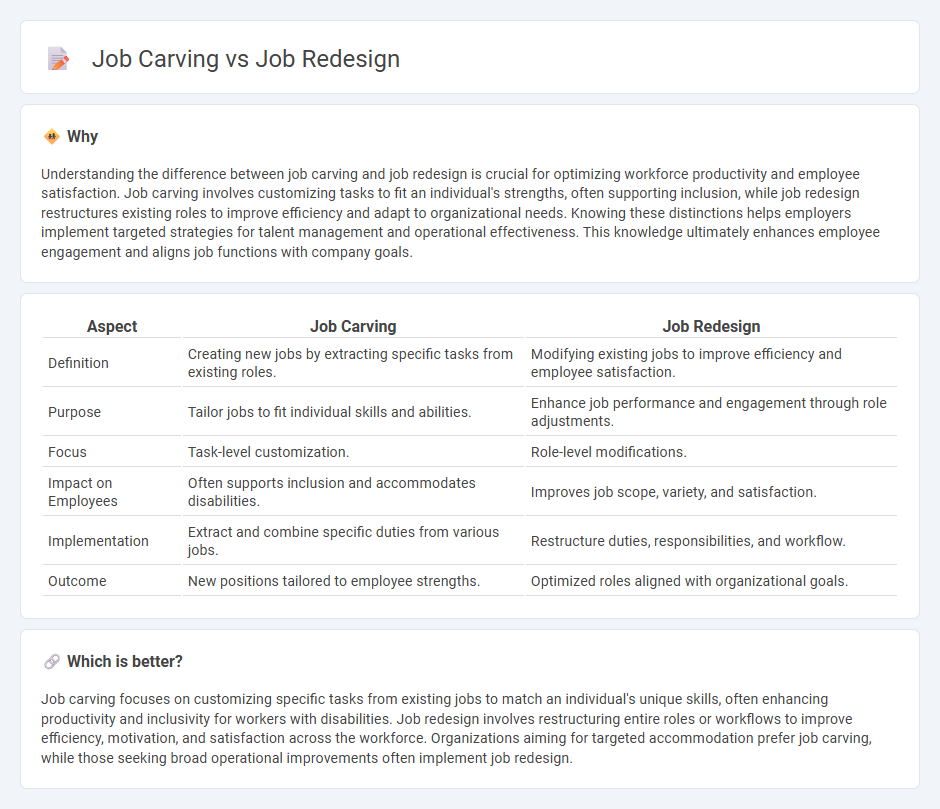
Job carving focuses on creating specialized roles by segmenting tasks from existing jobs to fit an individual's unique skills, often benefiting employees with disabilities. Job redesign involves restructuring entire roles or workflows to improve efficiency, employee satisfaction, and organizational outcomes. Explore how these strategies can enhance workplace inclusion and productivity.
Why it is important
Understanding the difference between job carving and job redesign is crucial for optimizing workforce productivity and employee satisfaction. Job carving involves customizing tasks to fit an individual's strengths, often supporting inclusion, while job redesign restructures existing roles to improve efficiency and adapt to organizational needs. Knowing these distinctions helps employers implement targeted strategies for talent management and operational effectiveness. This knowledge ultimately enhances employee engagement and aligns job functions with company goals.
Comparison Table
| Aspect | Job Carving | Job Redesign |
|---|---|---|
| Definition | Creating new jobs by extracting specific tasks from existing roles. | Modifying existing jobs to improve efficiency and employee satisfaction. |
| Purpose | Tailor jobs to fit individual skills and abilities. | Enhance job performance and engagement through role adjustments. |
| Focus | Task-level customization. | Role-level modifications. |
| Impact on Employees | Often supports inclusion and accommodates disabilities. | Improves job scope, variety, and satisfaction. |
| Implementation | Extract and combine specific duties from various jobs. | Restructure duties, responsibilities, and workflow. |
| Outcome | New positions tailored to employee strengths. | Optimized roles aligned with organizational goals. |
Which is better?
Job carving focuses on customizing specific tasks from existing jobs to match an individual's unique skills, often enhancing productivity and inclusivity for workers with disabilities. Job redesign involves restructuring entire roles or workflows to improve efficiency, motivation, and satisfaction across the workforce. Organizations aiming for targeted accommodation prefer job carving, while those seeking broad operational improvements often implement job redesign.
Connection
Job carving and job redesign both focus on optimizing employment by tailoring roles to individual skills and organizational needs, enhancing productivity and job satisfaction. Job carving involves breaking down tasks from existing positions to create customized roles for workers, often benefiting those with disabilities or specialized talents. Job redesign expands this concept by restructuring entire jobs or workflows to improve efficiency, employee engagement, and alignment with business objectives.
Key Terms
Task Allocation
Job redesign involves restructuring entire roles to enhance efficiency and employee satisfaction by reallocating tasks, altering workflows, and modifying job scopes. Job carving focuses specifically on extracting particular tasks from existing jobs to create new positions tailored to employees' abilities, often used for workforce inclusion and optimization. Explore detailed strategies and benefits to effectively align task allocation with organizational goals.
Customization
Job redesign involves restructuring existing roles to improve efficiency and employee satisfaction by altering tasks, workflows, or responsibilities. Job carving focuses on customizing positions by extracting specific tasks from multiple jobs to fit an individual's unique skills, often used in workforce accommodation strategies. Explore detailed comparisons to understand which customization approach best suits your organizational goals.
Employee Strengths
Job redesign involves restructuring entire job roles to better align tasks with employee capabilities, enhancing efficiency and satisfaction. Job carving focuses on customizing specific duties from multiple roles to match an individual's unique strengths, often used for workforce inclusion. Explore the nuances of job redesign and job carving to maximize employee potential and organizational success.
Source and External Links
Job Redesign: A Practical Guide to Redesigning Jobs & Roles - AIHR - Job redesign is the process of restructuring tasks and responsibilities to adapt roles to changing organizational and environmental needs, often executed through a five-phase structured approach starting with identifying changing realities like new skills or automation requirements.
Job Redesign Definition, Steps & Examples - Lesson - Study.com - Job redesign involves reallocating tasks through methods like job enrichment, enlargement, or rotation, and follows a six-step managerial process to clarify roles, determine skill fit, reassign tasks, provide training, implement changes, and revisit outcomes to ensure employee and organizational alignment.
What Is Job Redesign? (Definition, Strategies and Components) - Job redesign modifies existing jobs to suit evolving business needs using strategies such as job rotation to widen skills, job enrichment to add motivational factors and autonomy, and job enlargement to increase task variety and responsibilities, all aimed at boosting productivity and engagement.