 dowidth.com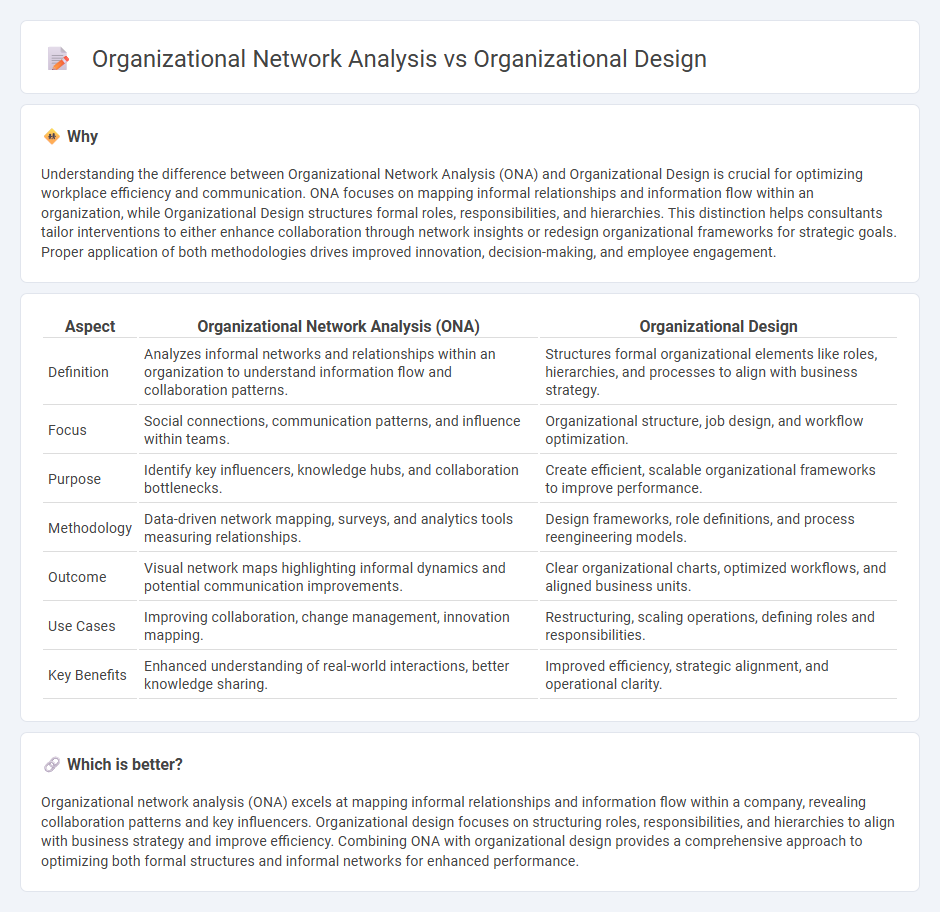
Organizational Network Analysis (ONA) maps informal relationships and communication patterns within a company, revealing collaboration and influence beyond the formal hierarchy. Organizational Design focuses on structuring roles, responsibilities, and workflows to align with strategic goals and improve efficiency. Discover how leveraging both ONA and organizational design can optimize your business performance.
Why it is important
Understanding the difference between Organizational Network Analysis (ONA) and Organizational Design is crucial for optimizing workplace efficiency and communication. ONA focuses on mapping informal relationships and information flow within an organization, while Organizational Design structures formal roles, responsibilities, and hierarchies. This distinction helps consultants tailor interventions to either enhance collaboration through network insights or redesign organizational frameworks for strategic goals. Proper application of both methodologies drives improved innovation, decision-making, and employee engagement.
Comparison Table
| Aspect | Organizational Network Analysis (ONA) | Organizational Design |
|---|---|---|
| Definition | Analyzes informal networks and relationships within an organization to understand information flow and collaboration patterns. | Structures formal organizational elements like roles, hierarchies, and processes to align with business strategy. |
| Focus | Social connections, communication patterns, and influence within teams. | Organizational structure, job design, and workflow optimization. |
| Purpose | Identify key influencers, knowledge hubs, and collaboration bottlenecks. | Create efficient, scalable organizational frameworks to improve performance. |
| Methodology | Data-driven network mapping, surveys, and analytics tools measuring relationships. | Design frameworks, role definitions, and process reengineering models. |
| Outcome | Visual network maps highlighting informal dynamics and potential communication improvements. | Clear organizational charts, optimized workflows, and aligned business units. |
| Use Cases | Improving collaboration, change management, innovation mapping. | Restructuring, scaling operations, defining roles and responsibilities. |
| Key Benefits | Enhanced understanding of real-world interactions, better knowledge sharing. | Improved efficiency, strategic alignment, and operational clarity. |
Which is better?
Organizational network analysis (ONA) excels at mapping informal relationships and information flow within a company, revealing collaboration patterns and key influencers. Organizational design focuses on structuring roles, responsibilities, and hierarchies to align with business strategy and improve efficiency. Combining ONA with organizational design provides a comprehensive approach to optimizing both formal structures and informal networks for enhanced performance.
Connection
Organizational network analysis (ONA) maps and measures informal relationships and communication patterns within a company, providing insights into how work actually flows beyond formal hierarchies. Organizational design leverages ONA data to create structures that optimize collaboration, efficiency, and innovation by aligning formal roles with actual interaction dynamics. Integrating ONA into organizational design enhances decision-making and change management by revealing hidden influencers and bottlenecks that traditional charts may overlook.
Key Terms
**Organizational Design:**
Organizational design concentrates on structuring roles, responsibilities, and workflows to optimize efficiency and achieve strategic objectives within a company. It involves creating formal systems and hierarchies that align resources with business goals, ensuring clarity in reporting lines and decision-making processes. Explore how organizational design shapes competitive advantage and operational success in greater detail.
Structure
Organizational design concentrates on creating formal structures, roles, and hierarchies to optimize workflow and achieve business objectives efficiently. Organizational Network Analysis (ONA) maps informal relationships and communication patterns, revealing real-time collaboration and knowledge flow within the organization. Explore how integrating these approaches enhances both structural alignment and dynamic connectivity in your enterprise.
Roles
Organizational design emphasizes structuring roles to define clear responsibilities, hierarchies, and workflows that align with strategic objectives. Organizational network analysis, however, examines informal relationships and interactions between roles to identify collaboration patterns and information flow within the company. Explore deeper insights to understand how these approaches shape effective role management.
Source and External Links
Organizational Design: A Complete Guide - Organizational design is the administration and execution of an organization's strategic plan, creating the best fit between the company's strategic choices and its organizational setting to align structure, control, and culture with strategy.
Organizational Design - Organizational design is the discipline of shaping an organization so that it better achieves its business strategy by aligning people and skills with work, designing roles, reporting lines, and workflows to encourage collaboration, adaptability, and goal achievement.
What is Organizational Design? - Organizational design is a step-by-step methodology to identify dysfunctional workflows and create an ideal future organization by defining structure, processes, roles, staffing, facilities, and management systems, culminating with transition and communication plans.