 dowidth.com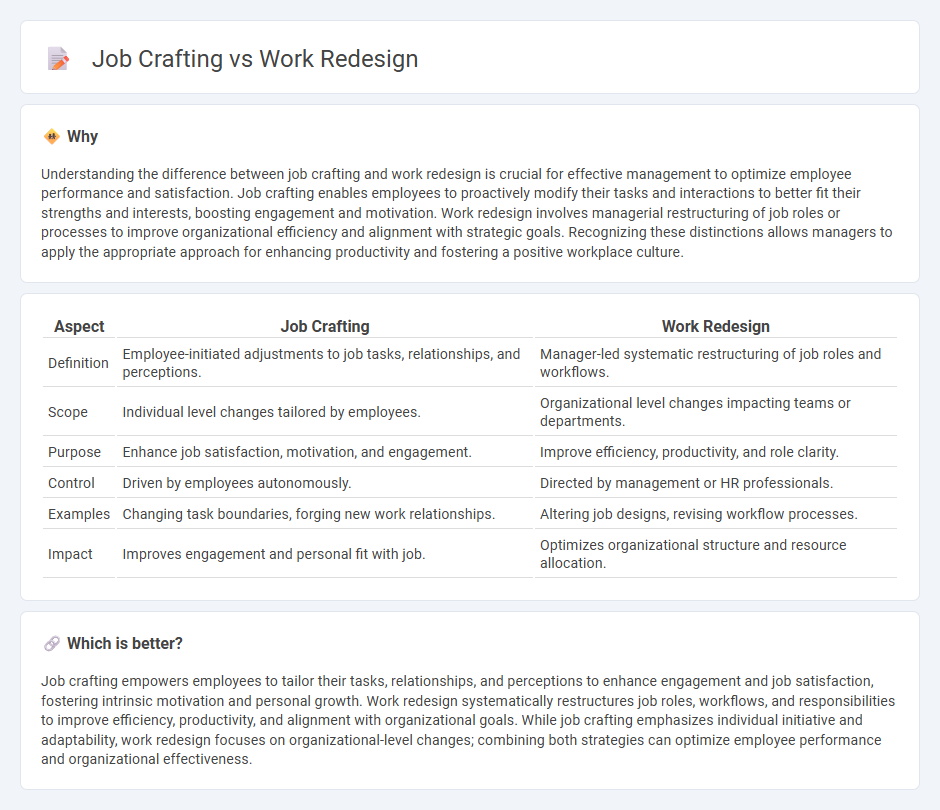
Job crafting empowers employees to tailor their tasks, relationships, and perceptions to enhance engagement and job satisfaction, while work redesign involves systematic changes to job structures and processes aimed at improving efficiency and organizational outcomes. Both approaches focus on aligning work with individual strengths and organizational goals but differ in scope, with job crafting being employee-driven and work redesign typically management-led. Explore the distinctions and benefits of job crafting versus work redesign to optimize workplace performance.
Why it is important
Understanding the difference between job crafting and work redesign is crucial for effective management to optimize employee performance and satisfaction. Job crafting enables employees to proactively modify their tasks and interactions to better fit their strengths and interests, boosting engagement and motivation. Work redesign involves managerial restructuring of job roles or processes to improve organizational efficiency and alignment with strategic goals. Recognizing these distinctions allows managers to apply the appropriate approach for enhancing productivity and fostering a positive workplace culture.
Comparison Table
| Aspect | Job Crafting | Work Redesign |
|---|---|---|
| Definition | Employee-initiated adjustments to job tasks, relationships, and perceptions. | Manager-led systematic restructuring of job roles and workflows. |
| Scope | Individual level changes tailored by employees. | Organizational level changes impacting teams or departments. |
| Purpose | Enhance job satisfaction, motivation, and engagement. | Improve efficiency, productivity, and role clarity. |
| Control | Driven by employees autonomously. | Directed by management or HR professionals. |
| Examples | Changing task boundaries, forging new work relationships. | Altering job designs, revising workflow processes. |
| Impact | Improves engagement and personal fit with job. | Optimizes organizational structure and resource allocation. |
Which is better?
Job crafting empowers employees to tailor their tasks, relationships, and perceptions to enhance engagement and job satisfaction, fostering intrinsic motivation and personal growth. Work redesign systematically restructures job roles, workflows, and responsibilities to improve efficiency, productivity, and alignment with organizational goals. While job crafting emphasizes individual initiative and adaptability, work redesign focuses on organizational-level changes; combining both strategies can optimize employee performance and organizational effectiveness.
Connection
Job crafting and work redesign both focus on enhancing employee engagement by modifying job tasks and responsibilities to better align with individuals' strengths and motivations. Job crafting involves employees proactively shaping their roles through altering task boundaries, relationships, and perceptions, while work redesign is a systematic organizational process that restructures jobs to improve efficiency and satisfaction. Together, they foster a dynamic work environment that promotes higher performance, job satisfaction, and organizational commitment.
Key Terms
Task Reconfiguration
Work redesign involves systematically restructuring job roles and tasks at the organizational level to improve efficiency and employee satisfaction, often driven by management initiatives. Job crafting, in contrast, is an employee-initiated process where individuals proactively modify their own tasks, relationships, and perceptions within their existing roles to enhance meaning and engagement. Explore further to understand how task reconfiguration in both approaches influences productivity and well-being.
Employee Autonomy
Work redesign involves organizational changes to tasks and structures that enhance employee autonomy by redesigning workflows and job roles to increase decision-making power. Job crafting allows employees to proactively adjust their job boundaries, tasks, and relationships to create a personalized work experience with greater autonomy and motivation. Explore the differences and benefits of these approaches to better support employee empowerment and engagement.
Organizational Objectives
Work redesign strategically aligns job roles and structures with organizational objectives to enhance efficiency and productivity. Job crafting empowers employees to personalize their tasks and interactions, fostering engagement while still supporting broader company goals. Explore in-depth strategies to balance work redesign and job crafting for optimal organizational success.
Source and External Links
What Is Job Redesign? - Discusses the definition, strategies, and components of job redesign, including job rotation, enrichment, and enlargement.
Job Redesign: A Practical Guide - Provides a structured five-phase approach to redesigning jobs and roles in response to changing organizational needs.
Work Redesign - Offers insights into the process of redesigning work, potentially involving concepts like job characteristics models and good work principles.