 dowidth.com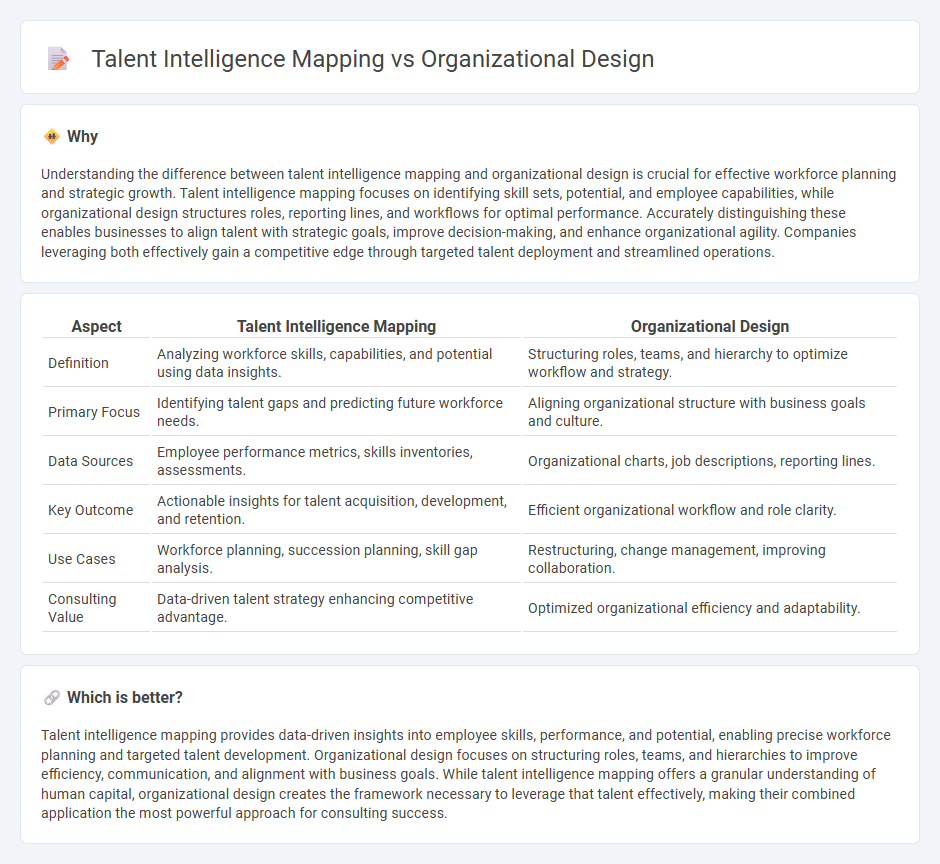
Talent intelligence mapping uncovers critical workforce insights by analyzing employee skills, performance, and market trends, enabling precise talent acquisition and development strategies. Organizational design focuses on structuring teams and workflows to optimize efficiency, collaboration, and business goals alignment. Explore the nuanced interplay between talent intelligence mapping and organizational design to elevate your consulting outcomes.
Why it is important
Understanding the difference between talent intelligence mapping and organizational design is crucial for effective workforce planning and strategic growth. Talent intelligence mapping focuses on identifying skill sets, potential, and employee capabilities, while organizational design structures roles, reporting lines, and workflows for optimal performance. Accurately distinguishing these enables businesses to align talent with strategic goals, improve decision-making, and enhance organizational agility. Companies leveraging both effectively gain a competitive edge through targeted talent deployment and streamlined operations.
Comparison Table
| Aspect | Talent Intelligence Mapping | Organizational Design |
|---|---|---|
| Definition | Analyzing workforce skills, capabilities, and potential using data insights. | Structuring roles, teams, and hierarchy to optimize workflow and strategy. |
| Primary Focus | Identifying talent gaps and predicting future workforce needs. | Aligning organizational structure with business goals and culture. |
| Data Sources | Employee performance metrics, skills inventories, assessments. | Organizational charts, job descriptions, reporting lines. |
| Key Outcome | Actionable insights for talent acquisition, development, and retention. | Efficient organizational workflow and role clarity. |
| Use Cases | Workforce planning, succession planning, skill gap analysis. | Restructuring, change management, improving collaboration. |
| Consulting Value | Data-driven talent strategy enhancing competitive advantage. | Optimized organizational efficiency and adaptability. |
Which is better?
Talent intelligence mapping provides data-driven insights into employee skills, performance, and potential, enabling precise workforce planning and targeted talent development. Organizational design focuses on structuring roles, teams, and hierarchies to improve efficiency, communication, and alignment with business goals. While talent intelligence mapping offers a granular understanding of human capital, organizational design creates the framework necessary to leverage that talent effectively, making their combined application the most powerful approach for consulting success.
Connection
Talent intelligence mapping provides critical insights into employee skills, competencies, and potential, enabling organizations to tailor their organizational design effectively. By aligning talent capabilities with strategic business goals, companies can optimize team structures, roles, and workflows to enhance performance and innovation. This integration facilitates agile organizational models that respond dynamically to market changes and workforce trends.
Key Terms
Organizational Design:
Organizational design structures workflows, roles, and hierarchies to align with company goals, enhancing efficiency and agility. It emphasizes optimal resource allocation and decision-making processes to support scalable growth and innovation. Discover how strategic organizational design can transform your business performance today.
Structure
Organizational design focuses on structuring roles, responsibilities, and workflows to optimize efficiency and alignment with business goals, while talent intelligence mapping strategically analyzes employee skills and potential to enhance workforce planning and development. Emphasizing structure, organizational design ensures clear hierarchies and processes, whereas talent intelligence mapping overlays talent insights onto this structure to identify gaps and opportunities. Explore in-depth how integrating these approaches can transform your company's effectiveness.
Governance
Organizational design focuses on structuring roles, responsibilities, and reporting lines to ensure clear governance frameworks that support decision-making and accountability. Talent intelligence mapping provides data-driven insights into workforce capabilities and potential, enabling leadership to align talent strategies with governance goals effectively. Explore further to understand how these approaches optimize organizational governance.
Source and External Links
Organizational Design: A Complete Guide - This guide provides a comprehensive overview of organizational design, including its definition, principles, and how it aligns with strategic plans.
What is Organizational Design? - This article outlines a step-by-step methodology for organizational design, focusing on optimizing workflows, structures, and systems.
8 Organizational Design Types - This resource describes various types of organizational structures, including functional, hierarchical, and matrix structures, and how to choose the best one for a company's goals.