 dowidth.com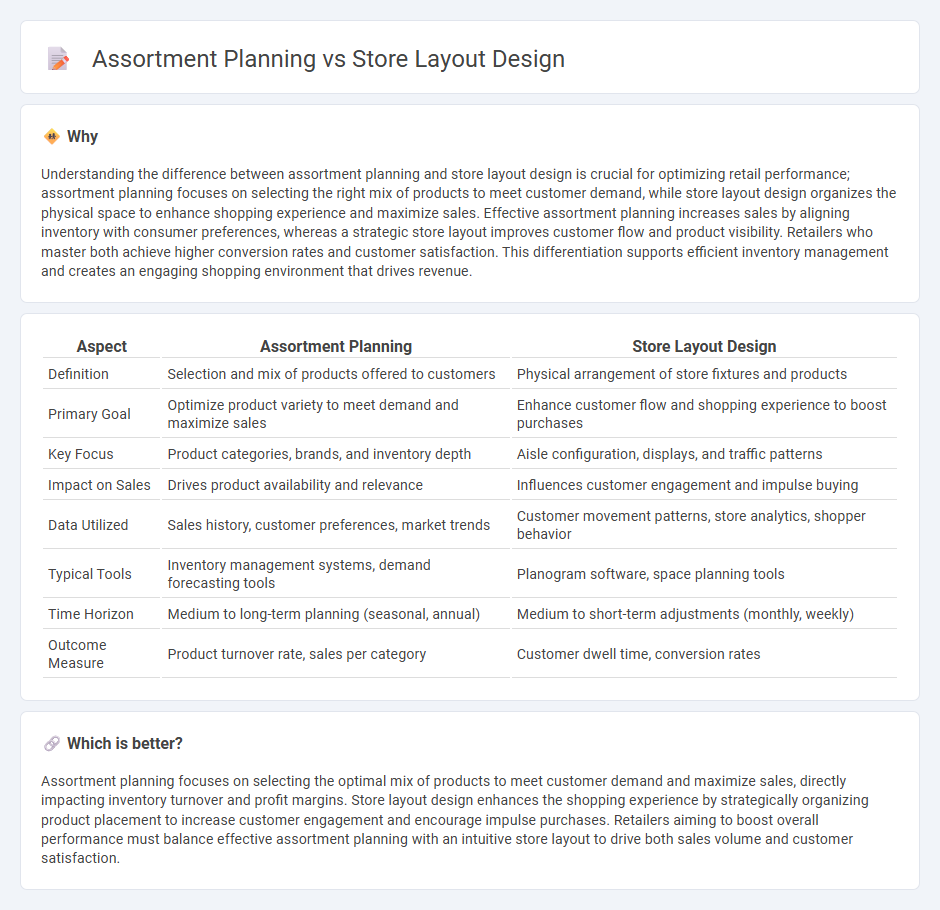
Assortment planning focuses on selecting the right mix of products to meet customer demand and maximize sales, while store layout design organizes physical space to enhance shopping experience and guide customer flow. Effective assortment planning relies on data analytics and customer preferences, whereas store layout design emphasizes visual merchandising and traffic patterns. Discover how integrating both strategies can drive retail success and boost profitability.
Why it is important
Understanding the difference between assortment planning and store layout design is crucial for optimizing retail performance; assortment planning focuses on selecting the right mix of products to meet customer demand, while store layout design organizes the physical space to enhance shopping experience and maximize sales. Effective assortment planning increases sales by aligning inventory with consumer preferences, whereas a strategic store layout improves customer flow and product visibility. Retailers who master both achieve higher conversion rates and customer satisfaction. This differentiation supports efficient inventory management and creates an engaging shopping environment that drives revenue.
Comparison Table
| Aspect | Assortment Planning | Store Layout Design |
|---|---|---|
| Definition | Selection and mix of products offered to customers | Physical arrangement of store fixtures and products |
| Primary Goal | Optimize product variety to meet demand and maximize sales | Enhance customer flow and shopping experience to boost purchases |
| Key Focus | Product categories, brands, and inventory depth | Aisle configuration, displays, and traffic patterns |
| Impact on Sales | Drives product availability and relevance | Influences customer engagement and impulse buying |
| Data Utilized | Sales history, customer preferences, market trends | Customer movement patterns, store analytics, shopper behavior |
| Typical Tools | Inventory management systems, demand forecasting tools | Planogram software, space planning tools |
| Time Horizon | Medium to long-term planning (seasonal, annual) | Medium to short-term adjustments (monthly, weekly) |
| Outcome Measure | Product turnover rate, sales per category | Customer dwell time, conversion rates |
Which is better?
Assortment planning focuses on selecting the optimal mix of products to meet customer demand and maximize sales, directly impacting inventory turnover and profit margins. Store layout design enhances the shopping experience by strategically organizing product placement to increase customer engagement and encourage impulse purchases. Retailers aiming to boost overall performance must balance effective assortment planning with an intuitive store layout to drive both sales volume and customer satisfaction.
Connection
Assortment planning directly influences store layout design by determining product variety and placement that maximize customer engagement and sales. Optimizing product categories and shelf space ensures a seamless shopping experience aligned with consumer preferences and buying behavior. Effective integration of assortment planning and store layout enhances inventory turnover and boosts overall retail performance.
Key Terms
**Store layout design:**
Store layout design strategically organizes physical space to optimize customer flow, enhance product visibility, and maximize sales per square foot. Key elements include aisle width, product placement, and focal points that align with shopper behavior patterns to boost engagement and purchase likelihood. Explore more about how effective store layout design drives retail success and customer satisfaction.
Traffic flow
Effective store layout design prioritizes traffic flow by strategically positioning aisles and product displays to guide customers seamlessly through the space, enhancing shopping experience and increasing dwell time. Assortment planning complements this by ensuring that product variety matches consumer demand within zoned areas, optimizing both accessibility and sales potential. Discover more about integrating these strategies to maximize retail performance.
Fixture placement
Fixture placement plays a crucial role in store layout design by optimizing customer flow and enhancing product visibility through strategic positioning. In assortment planning, fixture placement ensures that selected product mixes are displayed effectively to maximize sales potential and improve shopper experience. Explore fixture placement strategies to elevate both store layout and assortment effectiveness.
Source and External Links
9 Retail Store Layouts & Tips for Designing Your Floor Plan - Describes nine basic store layouts like grid, loop, spine, boutique, and more, explaining their best use cases, pros, and cons for optimizing retail space and customer experience.
Retail Store Layout: 10 Ideas, Examples & Tips (2024) - Shopify - Covers about 10 store layout types including straight/spine and diagonal layouts, detailing how they guide customer flow and impact product exposure in retail spaces.
Everything You Need to Know about Retail Store Layouts in 2025 - Explains innovative layout options such as geometric and hybrid layouts that allow detailed theming and mixed approaches for diverse retail needs and large-scale stores.