 dowidth.com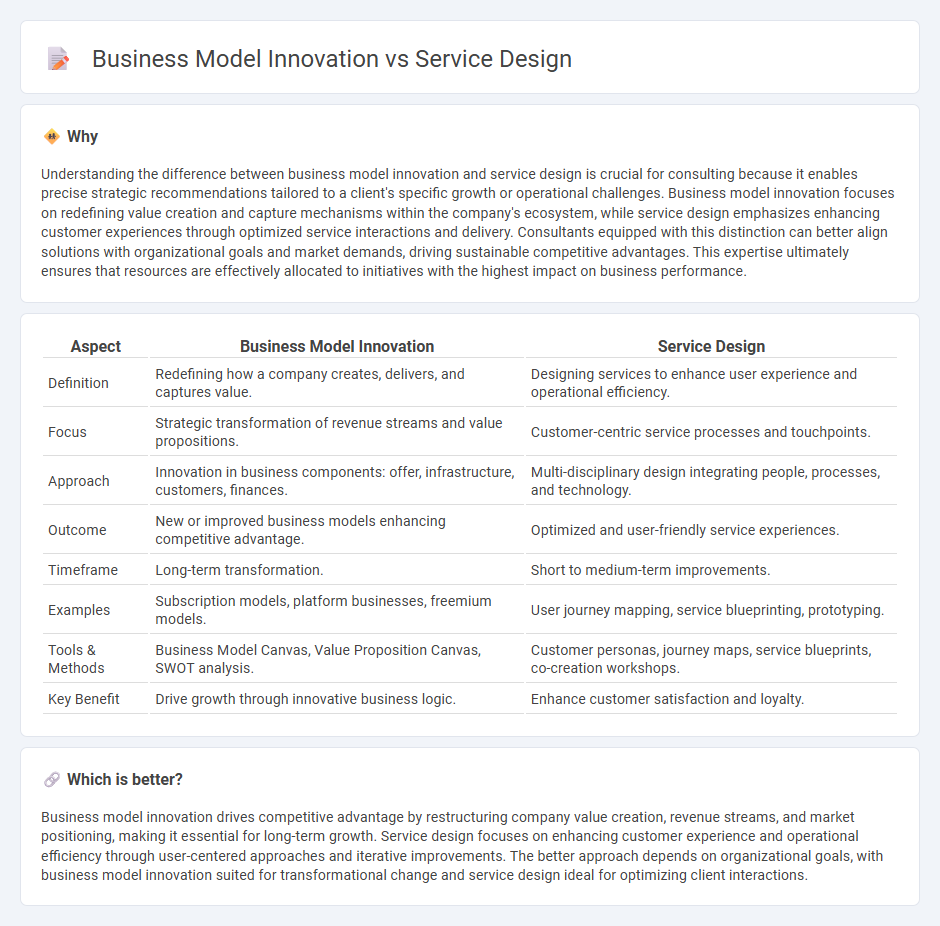
Business model innovation focuses on redefining an organization's core value propositions, revenue streams, and customer segments to create new market opportunities, while service design emphasizes optimizing user experiences and operational processes to deliver superior service quality. Both approaches leverage customer insights and digital technologies but differ in scope, with business model innovation shaping strategic direction and service design enhancing tactical execution. Discover how integrating these disciplines can drive transformative growth for your business.
Why it is important
Understanding the difference between business model innovation and service design is crucial for consulting because it enables precise strategic recommendations tailored to a client's specific growth or operational challenges. Business model innovation focuses on redefining value creation and capture mechanisms within the company's ecosystem, while service design emphasizes enhancing customer experiences through optimized service interactions and delivery. Consultants equipped with this distinction can better align solutions with organizational goals and market demands, driving sustainable competitive advantages. This expertise ultimately ensures that resources are effectively allocated to initiatives with the highest impact on business performance.
Comparison Table
| Aspect | Business Model Innovation | Service Design |
|---|---|---|
| Definition | Redefining how a company creates, delivers, and captures value. | Designing services to enhance user experience and operational efficiency. |
| Focus | Strategic transformation of revenue streams and value propositions. | Customer-centric service processes and touchpoints. |
| Approach | Innovation in business components: offer, infrastructure, customers, finances. | Multi-disciplinary design integrating people, processes, and technology. |
| Outcome | New or improved business models enhancing competitive advantage. | Optimized and user-friendly service experiences. |
| Timeframe | Long-term transformation. | Short to medium-term improvements. |
| Examples | Subscription models, platform businesses, freemium models. | User journey mapping, service blueprinting, prototyping. |
| Tools & Methods | Business Model Canvas, Value Proposition Canvas, SWOT analysis. | Customer personas, journey maps, service blueprints, co-creation workshops. |
| Key Benefit | Drive growth through innovative business logic. | Enhance customer satisfaction and loyalty. |
Which is better?
Business model innovation drives competitive advantage by restructuring company value creation, revenue streams, and market positioning, making it essential for long-term growth. Service design focuses on enhancing customer experience and operational efficiency through user-centered approaches and iterative improvements. The better approach depends on organizational goals, with business model innovation suited for transformational change and service design ideal for optimizing client interactions.
Connection
Business model innovation and service design are interconnected through their focus on creating value and enhancing customer experience. Business model innovation redefines how an organization delivers value, while service design ensures that the customer journey is seamless and user-centric. Integrating both disciplines drives sustainable growth by aligning operational strategy with customer needs.
Key Terms
Customer Journey Mapping
Customer Journey Mapping enhances service design by visualizing customer interactions to identify pain points and opportunities for improvement. In contrast, business model innovation uses insights from the customer journey to create new value propositions, revenue streams, or cost structures aligned with customer needs. Explore how integrating Customer Journey Mapping can transform both service design and business model innovation strategies.
Value Proposition
Service design enhances the value proposition by creating user-centered experiences that address customer needs through seamless interactions and efficient service delivery. Business model innovation reshapes the value proposition by redefining how value is created, delivered, and captured, often introducing new revenue streams and market opportunities. Explore how integrating service design and business model innovation can optimize your value proposition for competitive advantage.
Revenue Streams
Service design enhances customer value by optimizing touchpoints and user experiences, directly impacting retention and satisfaction, which indirectly supports revenue growth. Business model innovation targets the structural framework of an enterprise, redefining revenue streams through new pricing strategies, market segments, or delivery methods. Explore how aligning innovative service design with business model evolution can maximize revenue potential.
Source and External Links
Service design - Wikipedia - Service design is the activity of planning and arranging people, infrastructure, communication, and material components to improve service quality and interaction between provider and users, often using visual representation techniques and multidisciplinary tools to create user-friendly, competitive services.
What is Service Design? | IxDF - The Interaction Design Foundation - Service design is a holistic, user-centered process creating sustainable and optimal service experiences across multiple channels, following five principles: user-centered, co-creative, sequencing, evidencing, and holistic design for all touchpoints.
What is Service Design | Designlab - Service design orchestrates the entire customer journey and internal company structure to deliver seamless experiences, emphasizing collaboration among stakeholders and focusing on five key principles: user-centricity, co-creation, sequencing, evidencing, and holistic continual improvement.